
“Everything Is Normal?”: A Masterclass in Economic Denial Amid a Gathering Storm

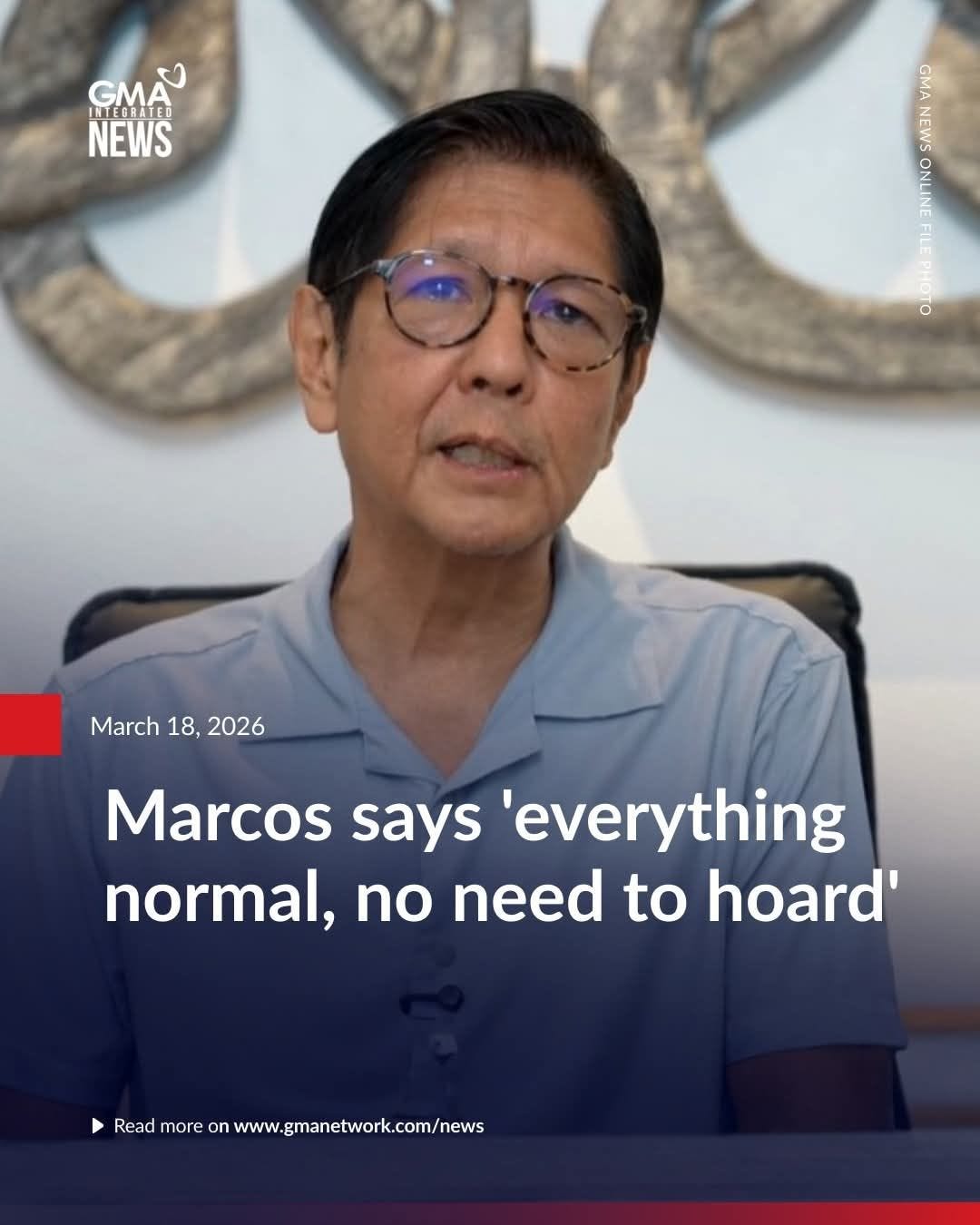
There is something profoundly unsettling, if not outright absurd, about declaring that “everything is normal” at a time when nearly every core indicator of the Philippine economy is flashing warning signals. Because let us be clear: NOTHING about the current situation resembles “normal.”
Start with the most basic reality confronting Filipino households. Rice prices are climbing toward more or less ₱70 per kilo in some areas. Electricity costs are rising, with potential increases of up to 16%, and Meralco is already imposing an additional ₱0.64/kWh, translating to roughly ₱128 more monthly for an average household. Fuel prices continue their upward march, driven by global oil prices now above $100 per barrel, with diesel already surging by over 38% in the early phase of the crisis.
There’s NOTHING normal about all these except the word, normal!
The problem with such a statement from Marcos Jr. is not merely that it is inaccurate. It is that it reflects a dangerous misreading, or worse, a dismissal of converging economic risks that are already visible, measurable, and intensifying.
Consider the currency. The Philippine peso has weakened to around ₱59.50–₱60 per US dollar, its lowest level in history. This is not a trivial fluctuation. For an import-dependent economy that sources 90–96% of its oil and other basic goods like rice from abroad, a weaker peso directly amplifies inflation. Every dollar increase in oil prices is now compounded by a depreciating currency.
But apparently, still, for Marcos Jr., no cause for concern? Everything normal?
Then there is the financial market. The PSEi plunging to the 6,000 level, wiping out ₱671.7 billion in market value in a single day, is not exactly what one would call a sign of investor confidence. Markets do not panic without reason. They react to risk, and right now, the risks are stacking up.
Meanwhile, the Department of Energy is reportedly scrambling to secure alternative oil shipments as April supply buffers begin to thin, even exploring discounted crude from Russia and the United States. Translation: supply is tightening, contingency measures are being rushed, and the window for stability is narrowing.
But of course—no need to hoard, says Marcos Jr.
Let us pause on that phrase.
Telling the public not to hoard presumes that supply is stable and that price movements are temporary. Yet the very same government is acknowledging logistical constraints, shrinking reserves, and exposure to disruptions in the Strait of Hormuz, which carries about 20% of global oil supply. When fuel stations in many places across the country begin running dry, those are NOT hypothetical risks; they are early-stage stress signals. Indeed, the contradiction is glaring.
Even policy responses betray the underlying anxiety. The House of Representatives has moved to authorize the President to suspend or reduce excise taxes on petroleum products during emergencies. Such a measure is not introduced in times of stability. It is a contingency tool, an admission that the situation may deteriorate further.
So again, one must ask: if everything is normal, why prepare emergency powers?
The deeper issue here is not simply about one statement. It is about credibility in economic signaling.
Markets, households, and businesses do not operate on reassurances alone. They respond to consistency between words and observable reality. When official statements diverge too far from lived experience—rising food prices, rising gasoline, diesel, kerosene, LPG, etc., higher electricity bills, a weakening currency- they risk eroding public trust.
And trust, once lost, is far more difficult to restore than price stability.
Beyond the immediate economic indicators lies a more structural vulnerability that the current crisis is exposing with brutal clarity. The Philippines is simultaneously:
Energy-dependent on Middle Eastern oil
Labor-dependent on OFWs in the same region (about 2.5 million workers, contributing $35.6 billion in remittances, with 18% from the Middle East)
Consumption-driven, with roughly 70% of GDP reliant on household spending
This is not diversification. This is a concentration risk.
When conflict erupts in the Middle East, it does not just affect oil prices—it threatens remittances, weakens the peso, fuels inflation, and slows growth all at once. Indeed, projections now suggest that GDP growth could fall below 5% in 2026, from an already weakened 4.4% in 2025.
And yet, in the face of this convergence of risks—energy shock, inflation, currency depreciation, financial volatility—the official message is reassurance. Perhaps too much reassurance.
Because what the public is witnessing is NOT stability. It is the early formation of a classic emerging-market stress cycle: oil shock + currency weakness + inflation + fiscal constraints (with a $26.5 billion deficit limiting policy space).
This is how crises begin, not with a dramatic collapse, but with a steady accumulation of pressures that are dismissed until they can no longer be contained.
Which brings us back to the statement: “Everything is normal, no need to hoard.”
One might argue that the intention was to prevent panic. Fair enough. But there is a fine line between calming the public and underestimating the gravity of the situation.
Because when fuel supply buffers are thinning, the peso is hitting historic lows, inflation is accelerating, and the government is quietly preparing emergency fiscal tools, the problem is not public panic.
The problem is official complacency. And in economics, complacency is often the most expensive mistake of all.
Madam Anna hindi na po katakataka. Ganyan na po mag-isip ang isang adik. Sa mundo ng mga adik sa cocain kahit nagliliparan na ang mga missiles ay "normal lang sa kanila".
Bakit nagka ganito na ang Pilipinas nating mahal, nababoy na ng husto ng gobyernong sindikato ng isang adik na presidente, nakaka galit, nakaka panlumo na parang wala nang nakikitang pag asa, makapal ang mukha, ayaw iwanan ang pwesto nya maski wala na syang silbi🤬